Destructive changes
How metadata is deleted from orgs — destructive changes per package type, how they move through validation and releases, and how left-behind components are tracked.
Deleting a component from a package removes it from your source — not from the orgs the package was already installed in. An org deletes metadata only when a destructive change ships to it. How a destructive change is expressed depends on the package's type.
Unlocked packages
The platform handles deletion as part of the version upgrade: metadata present in the installed version but missing from the new one is removed when the new version installs. codev installs unlocked packages in mixed mode, so components the platform can delete are deleted; components the platform only deprecates — such as custom fields holding user data, or components still referenced elsewhere — remain in the org for manual removal. Engine reference: Destructive changes.
Source and diff packages
A source package (and its diff variant) expresses deletions through two folders inside the package directory: components in pre-destructive/ are deleted before the package's contents deploy, components in post-destructive/ after.
src/feature-management/
├── main/
│   └── default/          # the package's components
├── pre-destructive/      # deleted before the deployment
└── post-destructive/     # deleted after the deployment
Metadata deployment applies the refactored components and their deletions in one transaction. Flows are an exception: by default, installation deactivates a Flow in either destructive folder and deletes every version before deploying the remaining metadata. If that deployment fails, the Flow remains deleted. References blocking Flow deletion must already be removed from the org. See Flow deletion and package controls.
Once the version carrying a destructive change has installed on every environment, remove the destructive folders in a follow-up change. There is no urgency — installs ignore warnings about components already absent from an org.
Data packages
A data package deletes records, not metadata, through the operations its export.json declares — a delete operation scoped by a query, or deleteOldData to remove records that no longer exist in the package before loading the rest. Engine reference: Destructive changes — data packages.
A destructive change is a change
Deletions travel the same lifecycle as any other change: they arrive on a pull request, validation deploys them to a review environment — the deletion is tested against a real org before the merge — the merge builds them into the artifact, and each release applies them to its environment.
A deletion can succeed in one org and fail in another, because what references the component differs per org. Watch the dependency implications across packages, and validate destructive changes on a review environment that resembles the target.
Tracking components left behind
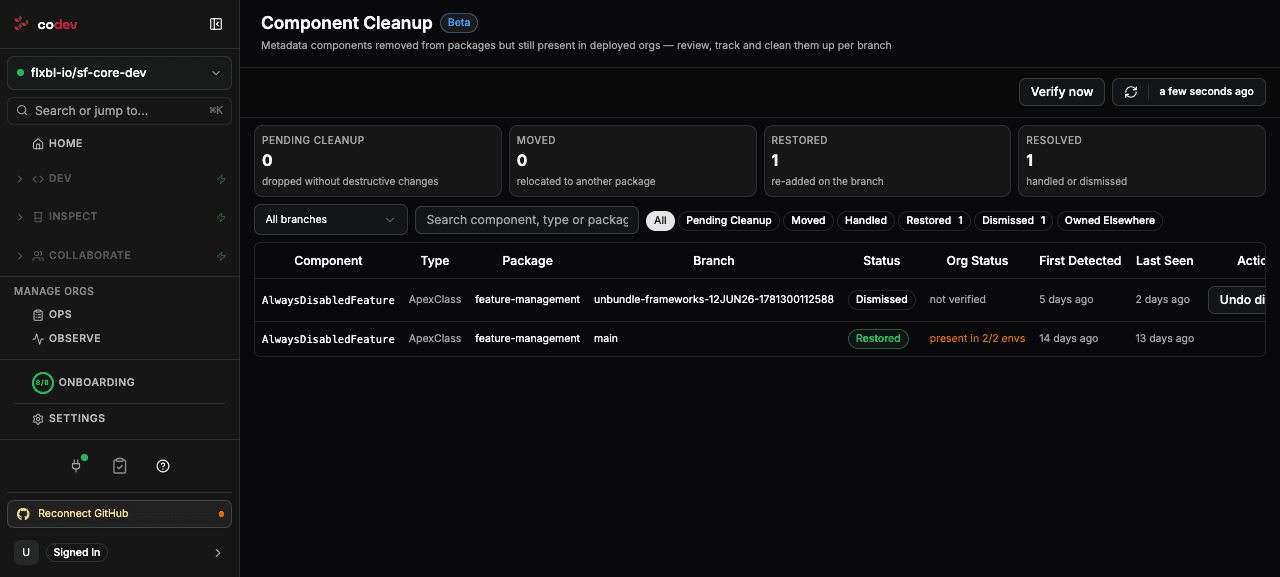
A component removed from a package without a destructive change stays in the orgs it was deployed to. codev's Component Cleanup records every component dropped from a package, per branch, with a status — pending cleanup, moved to another package, handled by a destructive change, restored, or dismissed — and verifies against each registered environment whether the component is actually still present. It tracks and verifies; the removal itself is a destructive change you ship through the package. See Component Cleanup.
Package installation
How artifacts install into an org — version skipping, component checksum skip, test execution per package type, and the behaviours baked in at build.
Release candidates and releases
What a release candidate is, how it becomes a release, and why deploying a candidate brings everything accumulated since the last release.