Stewards and companions
How a Workfloor lane can run Flux as a stage steward for a whole stage and its queue, and as companions and helpers beside a card's own agent.
The agent at a stage works on one card. A lane can also run Flux in roles that look wider than one card or work beside it: a stage steward for a whole stage, and companions and helpers next to a card's own agent. A lane author chooses them in the lane editor. Assembly lanes describes the editor.
Stage steward
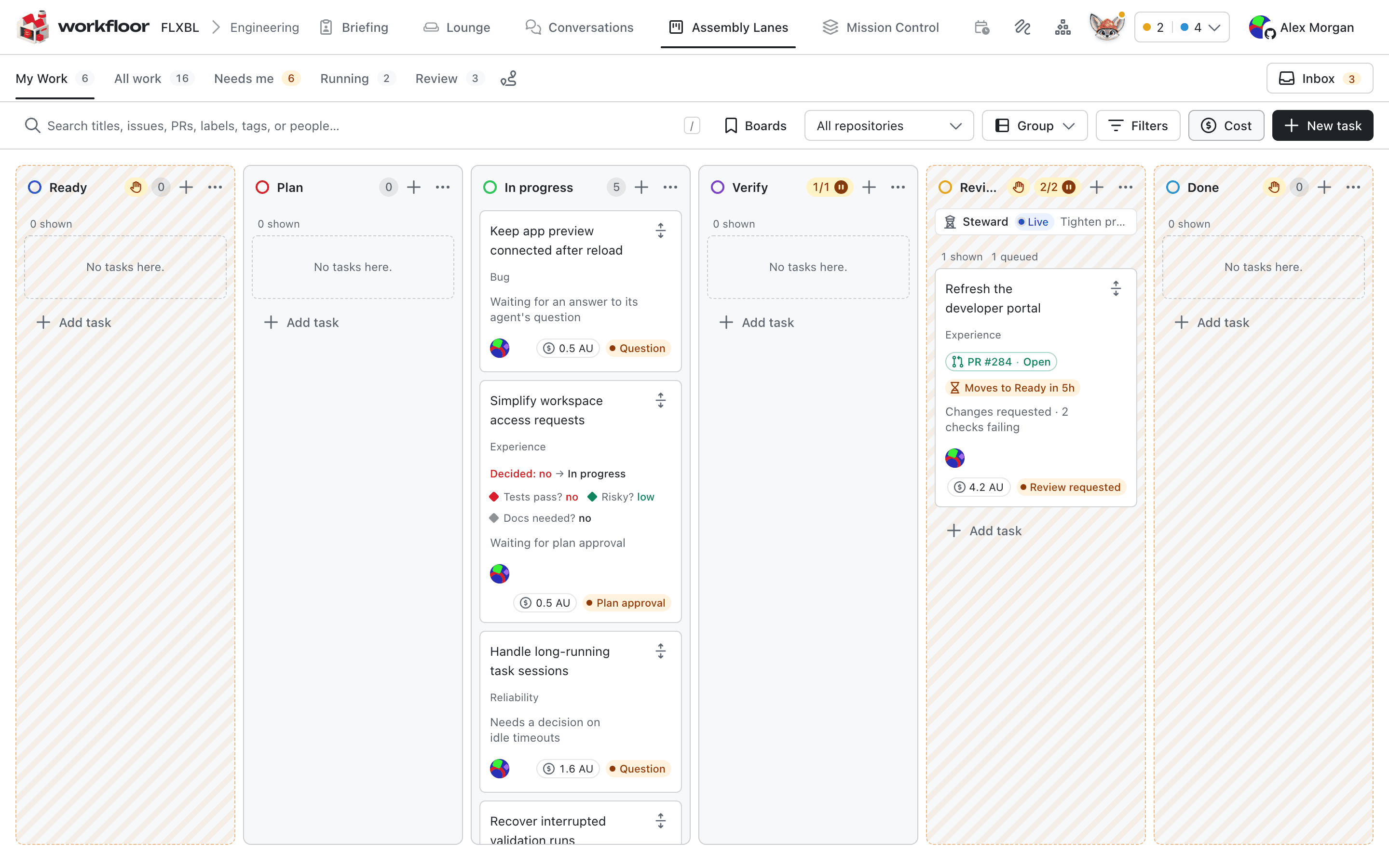
A stage steward is Flux looking after a whole stage: every card in it and every card queued at its door. It is one session that wakes when the lane author says, reads the stage's queue, writes to the cards' agents and leaves a short note on the column.
Set one up
A project admin opens a work stage in the lane editor (Settings > Projects, the project, Workflow, Edit workflow) and chooses Steward in the stage's settings, then Add a steward.
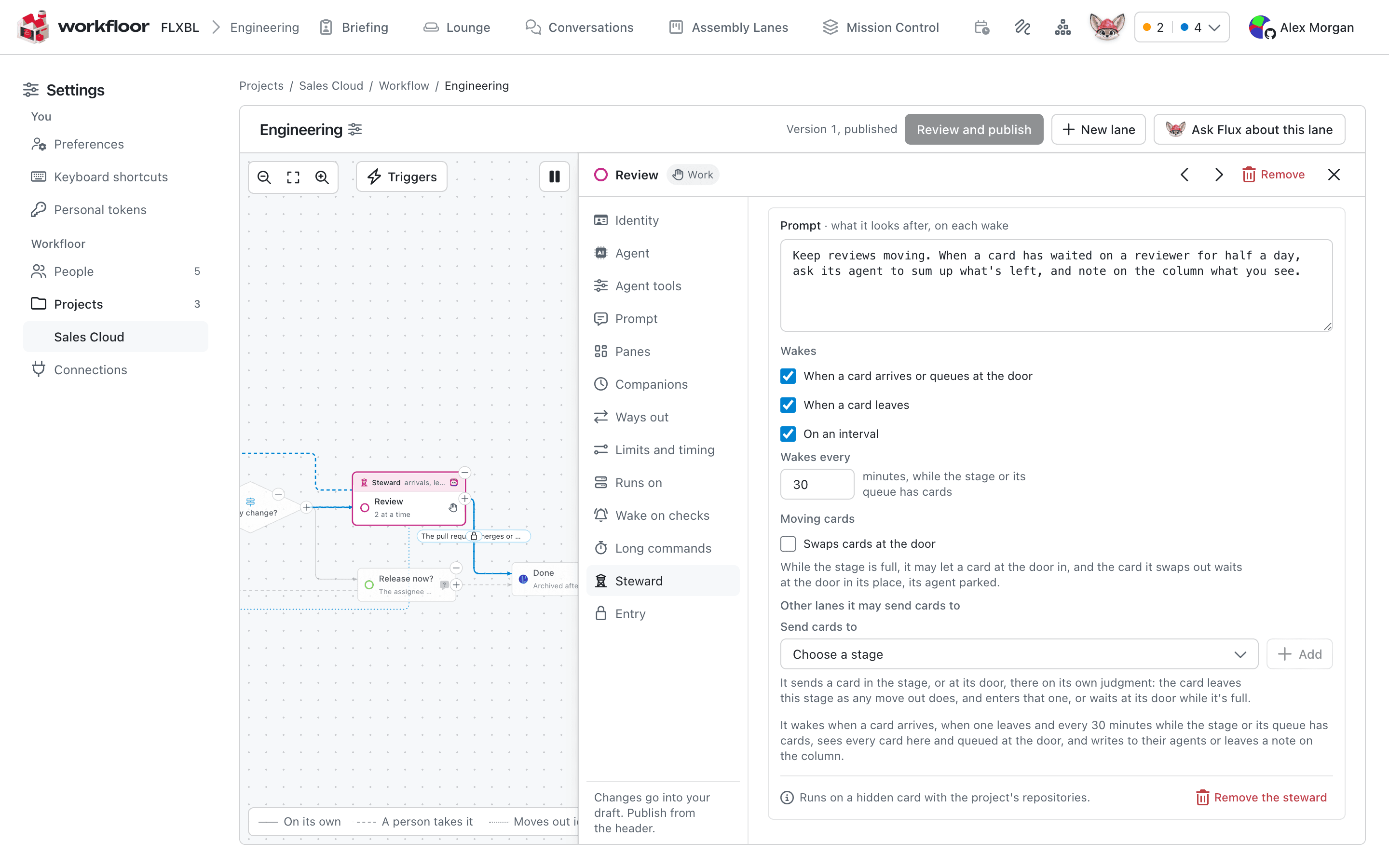
- Prompt. What it looks after on each wake, for example "keep reviews moving: when a card has waited on a reviewer for half a day, ask its agent to sum up what is left."
- Wakes. When a card arrives or queues at the door, when a card leaves, and on an interval of a number of minutes while the stage or its queue has cards.
- Moving cards. What the lane lets it do to cards, below.
The lane takes effect when the admin publishes it. Remove the steward takes it away; its session ends.
What it can do
On every wake Flux reads the stage's queue: each card's agent state, what it waits on, its open dependencies and its pull requests. Without any setting beyond a prompt it can write to a card's agent, write to another stage's steward in the same project, order the cards queued at the door (higher-priority work stays ahead, as set by missions), say that a card in its stage or at its door waits for another card of the project, and leave a note. A card it says waits is held at the stage until the other card is done; a person can remove the wait. The lane author can give it more:
- Move cards. It moves a card in its stage, or queued at its door, only along a way out of the stage that names the steward.
- Start a waiting card's agent. On the stage's Agent setting, Starts can be By the steward: a card then waits for the steward to start its agent. Starts anyway after sets the longest wait; after that, or at once while the steward is not running, the agent starts. The steward can also put a started card back to waiting, which parks its session.
- Swap cards at the door. With Swaps cards at the door on a stage that has a WIP limit, Flux can let a card at the door in while the stage is full. The card it swaps out waits at the door in its place, with its agent parked.
- Send a card to another lane. Other lanes it may send cards to lists the stages in other lanes of the project it may send a card to, on its own judgment. The card leaves as any move does and enters that stage, or waits at its door while it is full.
- Group cards. Where the stage has a way out for a group's outcome, it can group cards, for example a stack of pull requests, so that one review of the top card covers the others. When the top card leaves with a verdict, the covered cards follow along that way.
Its notes, its groups and the cards it holds show in the steward's panel.
What it never does
It does not approve a gate or pass a decision. It cannot move a card along a way out that does not name it.
Read it, write to it, stop it
Selecting the strip opens Steward of the stage.
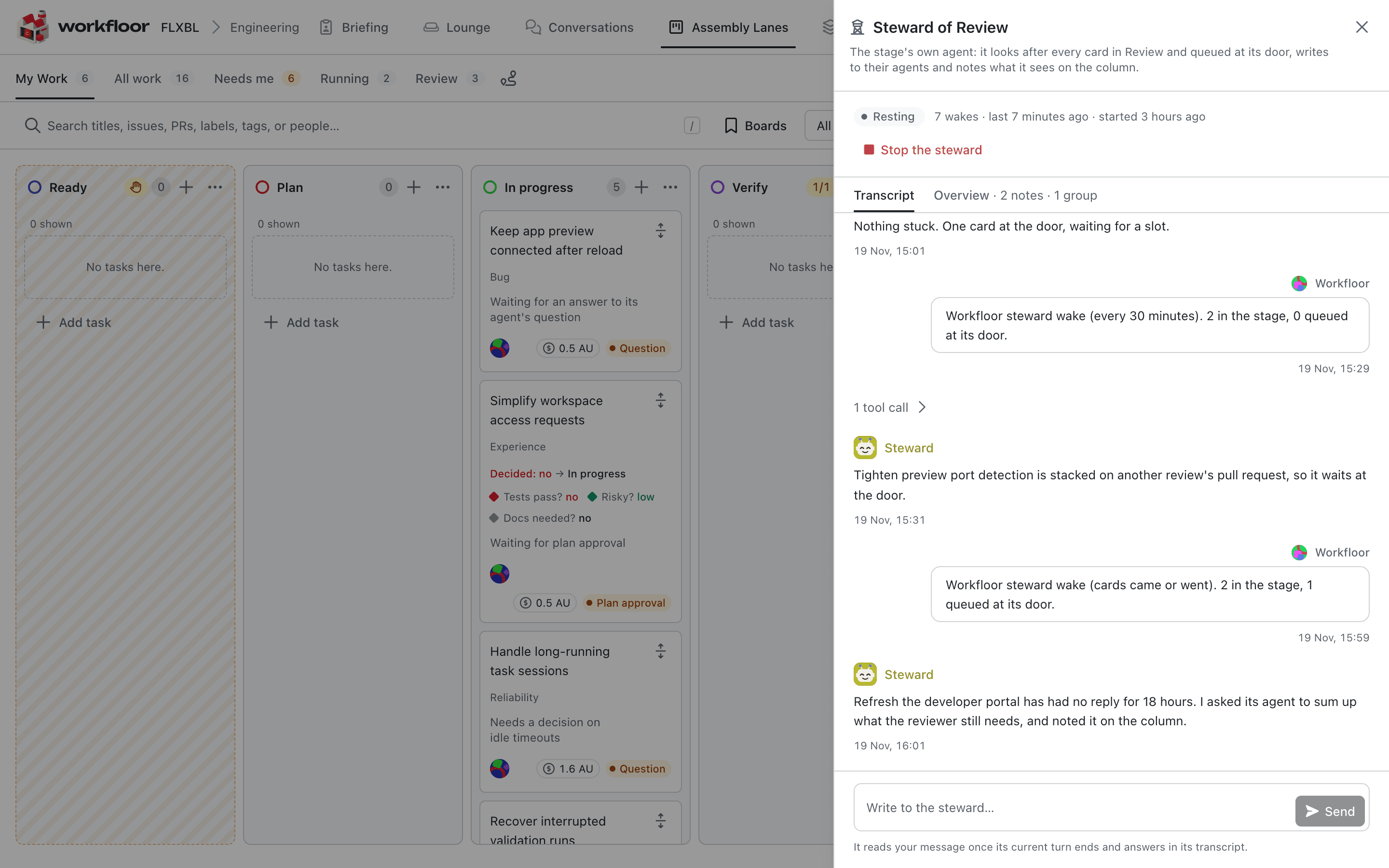
The panel shows its state, the number of wakes and its transcript. Overview lists its notes, its groups and the cards it holds.
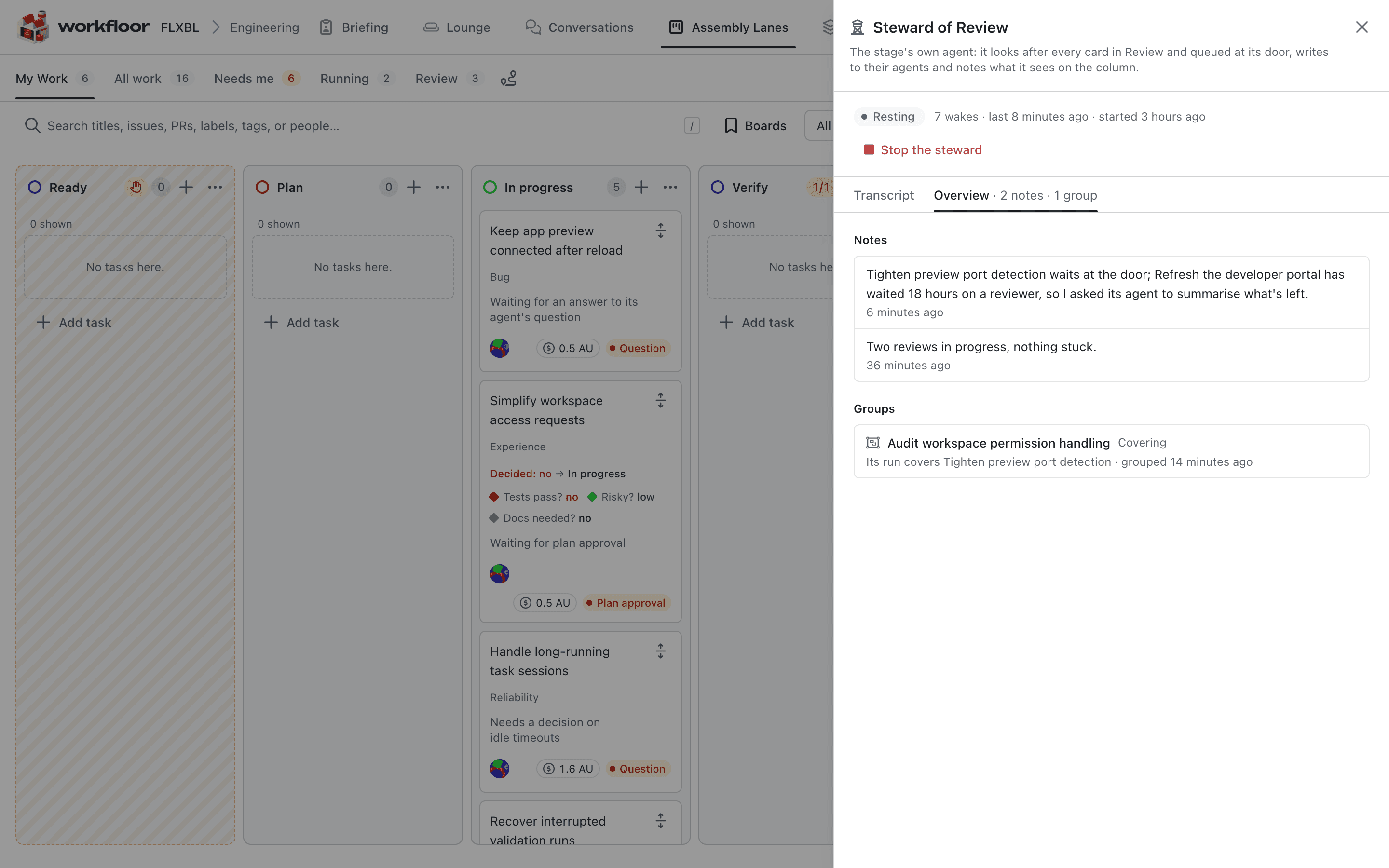
A member writes to the steward from the box at the bottom; Flux reads it on its next wake. A card's own agent and another stage's steward can write to it too. A project admin chooses Stop the steward, after a confirmation, and later Restart the steward. A steward ends, and cannot be restarted, when a published version of the lane removes it or the lane is deleted.
Companions
A companion is a second Flux session that a lane runs beside the stage's agent, in the card's workspace, while a card is in the stage. It is for review, watching tests or keeping notes as the agent works. A companion never moves the card.
In a stage that has an agent, Companions has Add a companion.
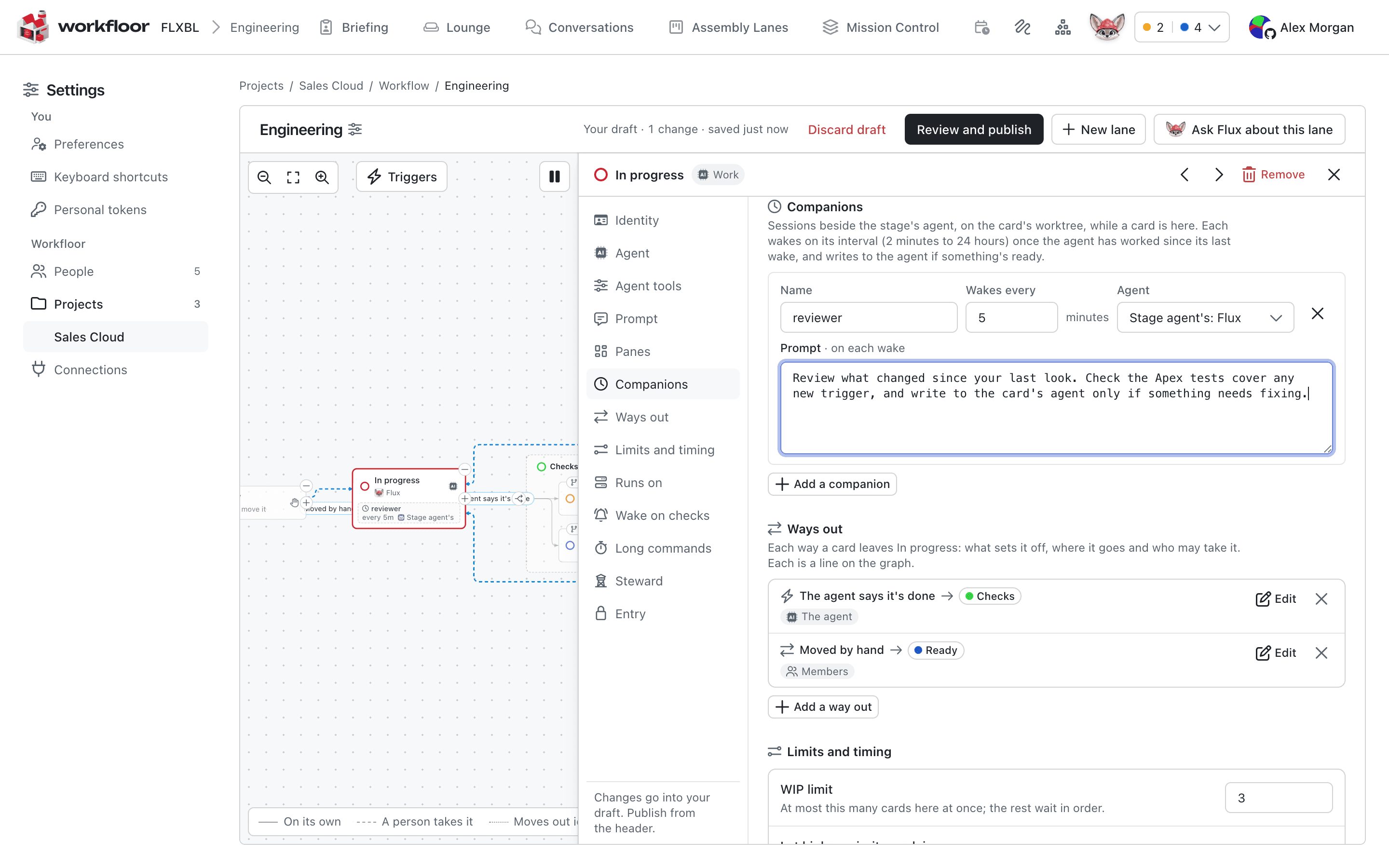
- Name. Lower case; unique within the stage.
- Wakes every. 2 minutes to 24 hours.
- Agent. The stage agent's by default, or another profile such as Flux's Review.
- Prompt. What it does on each wake.
A companion is woken when its interval has passed and the card's agent has worked since its last wake. It writes to the card's agent when something needs attention. Companions share the card's workspace with the agent and with each other, so each needs its own job.
A companion ends when the card leaves the stage or is archived. A person can end one earlier: on the card's sessions, Stop next to the companion. The card's assignee or a project admin can. A stopped companion is not woken again until the card enters the stage again, and the card's agent is told who stopped it.
Helpers
A helper is another session on the card's workspace that the card's own Flux starts itself, for a review, a second opinion or an investigation. A helper reports back to the card's agent and says when it is finished; it never moves the card, and it ends when the card leaves the stage it was started in. A lane can turn helpers off with Start helper sessions in its agent tools settings. The card's assignee or a project admin can Stop one. If the card's own session fails, the newest live helper takes over as the card's agent.
Next: Approvals between stages.
Approvals between stages
How a Workfloor lane stops a Salesforce card from moving on until someone agrees, through protected ways out, plan approval, judged decisions, Flux's questions and permission requests.
Missions
How a Workfloor mission groups the issues, pull requests, cards and planned items behind one outcome, orders them, sets their priority and tracks them to release.